Letter from The Director: A Frederick Douglass Moment
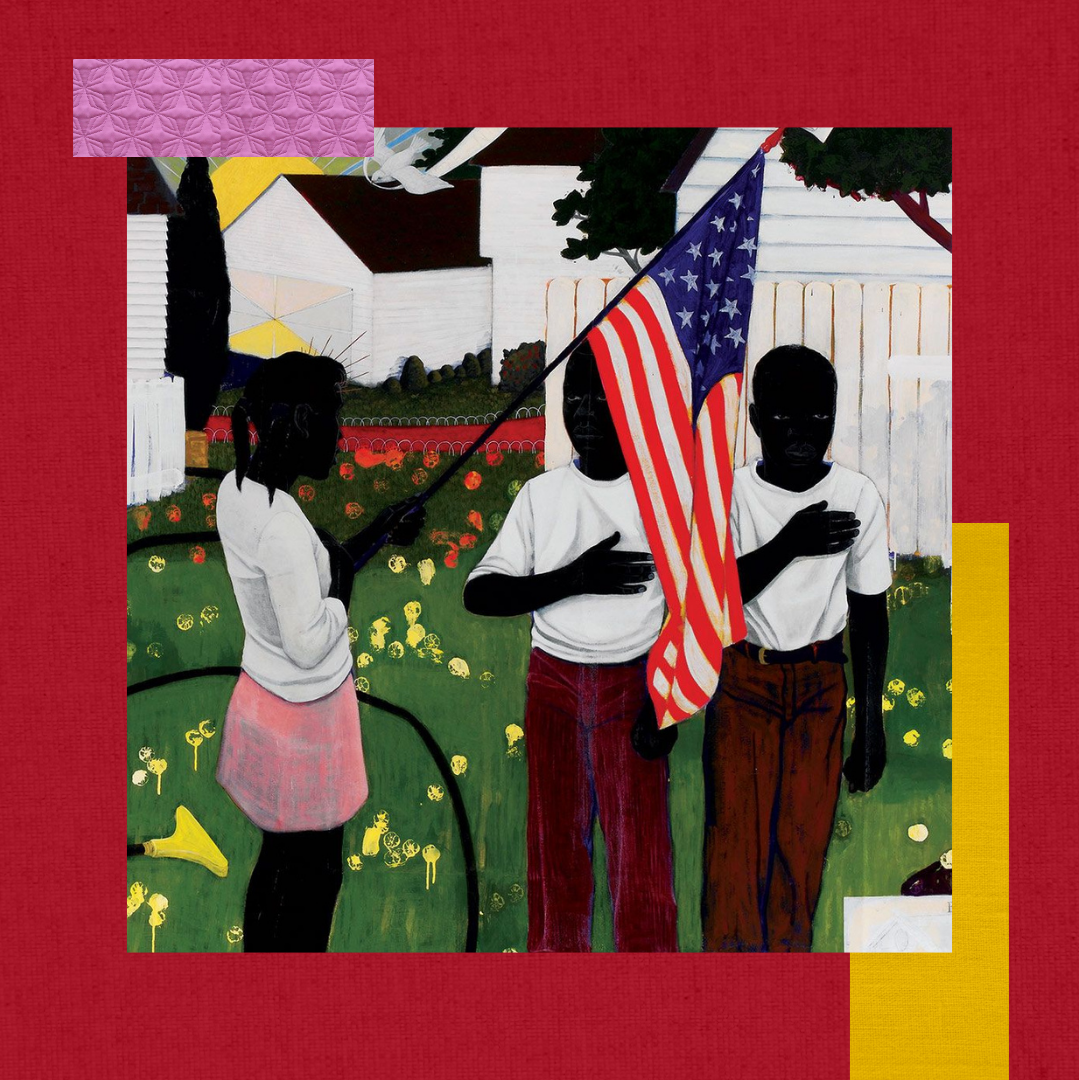
Kerry James Marshall, Bang, 1994.
“When it is finally ours, this freedom, this liberty, this beautiful / and terrible thing, needful to man as air... / this man, superb in love and logic, this man / shall be remembered.”
— Robert Hayden
As we approach the country’s 250th year of self-governance and the elaborate celebrations that are scheduled to mark the 4th of July, I am having a Frederick Douglass moment. In his oration delivered in Corinthian Hall in Rochester, New York, July 5, 1852, he levels a candid critique of this nation that is regrettably familiar in our times:
What, to the American slave, is your 4th of July? I answer: a day that reveals to him, more than all other days in the year, the gross injustice and cruelty to which he is the constant victim. To him, your celebration is a sham; your boasted liberty, an unholy license; your national greatness, swelling vanity; your sounds of rejoicing are empty and heartless; your denunciations of tyrants, brass fronted impudence; your shouts of liberty and equality, hollow mockery; your prayers and hymns, your sermons and thanksgivings, with all your religious parade, and solemnity, are, to him, mere bombast, fraud, deception, impiety, and hypocrisy—a thin veil to cover up crimes which would disgrace a nation of savages.
Today's national headlines may as well read, "federal and state officials held a seance seeking the return of the likes of Roger B. Taney, who ruled in the Dred Scott decision, Rebecca Latimer Felton, a suffragette who was a virulent advocate of the lynching of Black men, or Eugene “Bull” Connor, a staunch segregationist who took his racist tactics into Alabama politics.” Recently, we have seen a series of legal and political moves that significantly weaken the Voting Rights Act of 1965, eroding the protections for Black and non-white voters and making it harder to challenge racially discriminatory redistricting. We have witnessed the rise of a federally funded militia given authority under the cloak of the U. S. Immigration and Customs Enforcement (ICE) to terrorize, imprison, and endanger the lives of many who are seeking freedom. We are daily bombarded with the hypocrisy of leaders who make a mockery of our cherished symbols of democracy and liberty.
I know, we sometimes feel that in the wake of these national attacks on our communities, we can do nothing. That this liberty which Douglass talks about will continue to be as elusive as it was 250 years ago, notwithstanding the elaborate show. However, as women who write, we have learned that words have power, and, just as Frederick Douglass used his platform to speak eloquently to allies and adversaries alike, we must break the silence around oppression and the violence that perpetuates it. The core evil Frederick Douglass attacks in his speech still resides in the hearts of white supremacists, BUT we, our people, have the power to remember the sacrifices of warriors like Frederick Douglass, Harriet Tubman, Ida B. Wells, Rosa Parks, Martin Luther King, and Malcolm X. Today, women who write must call out both the “majority in power” and the self-centered, deluded people who passively assist in that oppression.
Joanne V. Gabbin
Executive Director
Wintergreen Women Writers Collective
Source: Oration, Delivered in Corinthian Hall, Rochester, by Frederick Douglass, July 5th, 1852 (Rochester: Lee, Mann & Co., 1852) from the Gilder Lehrman Institute of American History (GLC06829)
Source: The Collected Poems of Robert Hayden (Liveright Publishing Corporation, 1966)
Related News